Resource · Soil science
Oklahoma Clay Soil and Why Foundations Move
Almost every foundation problem in Oklahoma traces back to the same thing: the ground under the house changes volume. Clay-rich soils absorb water and swell, then dry out and shrink, and our weather drives that cycle harder than most of the country — long dry summers punctuated by heavy storms.
Understanding the mechanism is what lets you tell a genuine repair recommendation from a scare tactic.
Mechanism
The shrink-swell cycle, one year at a time
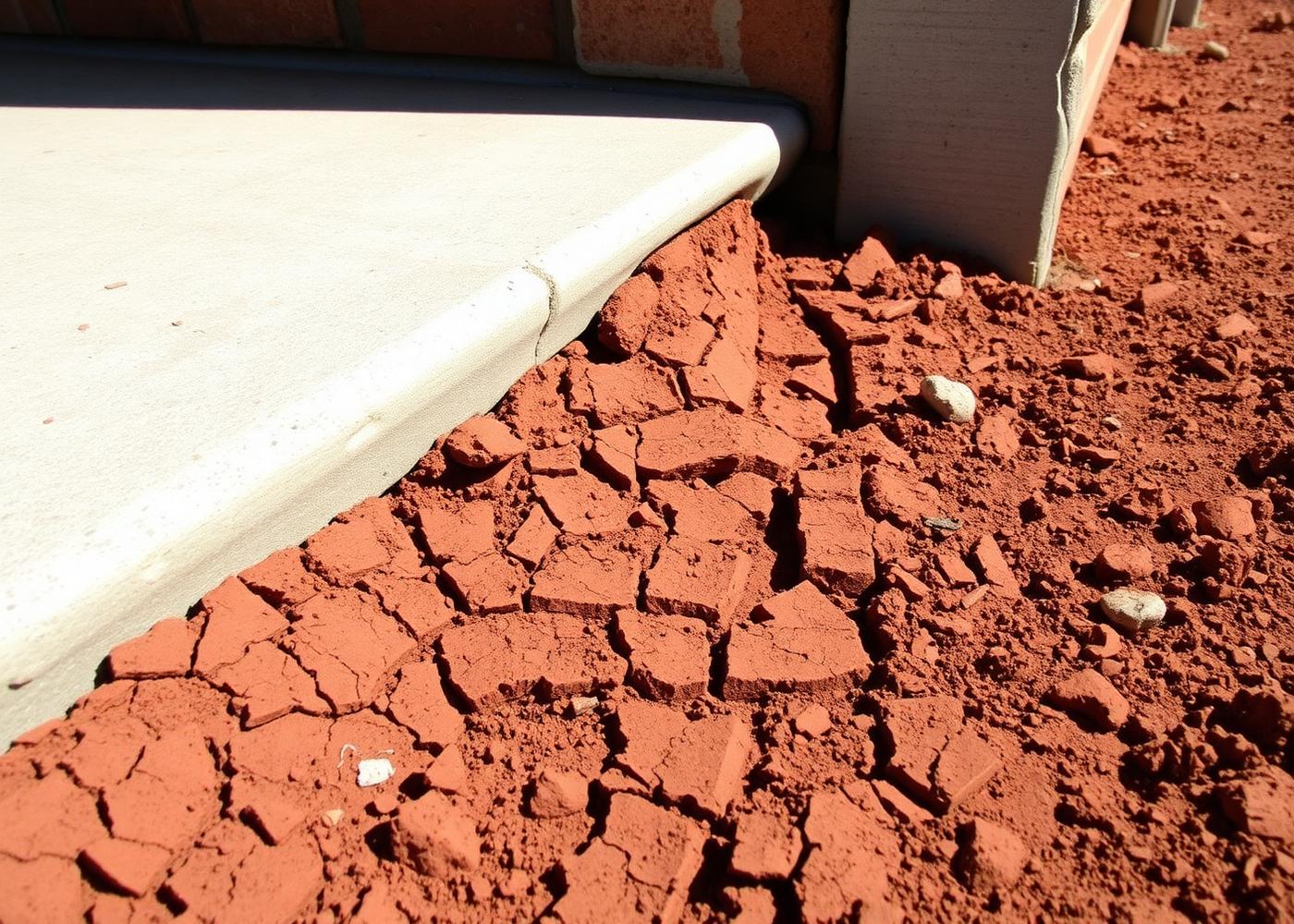
The same soil moves in both directions across a single Oklahoma year. Foundations fail from the difference between one part of the house and another, not from the movement itself.
Expansive clays contain minerals whose structure takes water in between its layers. As moisture arrives, the soil mass grows and pushes upward on whatever sits on it. As moisture leaves, it contracts and withdraws support. In an Oklahoma summer you can watch this happen — those wide separation cracks that open along a slab edge in August are the soil physically pulling away from the house.
A slab riding uniformly up and down would be largely fine. The damage comes from differential movement: the shaded north side stays moist while the sun-exposed south side dries; a downspout keeps one corner saturated while the far corner bakes; a mature elm pulls moisture from one wall's root zone and nowhere else. The structure is forced to span the difference, and something has to give — mortar joints, drywall at door openings, tile grout.
This is also why repair without water management is a partial answer. Piers carry the load below the active zone, which solves the structural problem. They do nothing about the moisture swings that caused it, which is why drainage corrections belong in the same conversation.
Regional variation
Conditions differ across the state
General patterns only — soil varies parcel to parcel, and only a site-specific evaluation speaks to your house.
Central Oklahoma
The Oklahoma City metro — including Edmond, Moore, Norman, and Yukon — sits largely on Permian red-bed clays and shales. Expansive behavior is common, with depth to firmer material varying considerably within a single neighborhood.
Northeast Oklahoma
Tulsa and Broken Arrow combine clay soils with shale and limestone, plus significant topographic relief. Slope, cut-and-fill lots, and stormwater routing play a larger role in how movement shows up.
Southwest Oklahoma
The Lawton area experiences pronounced drought cycles, with granite and gypsum in the broader geology alongside clay soils. Extended dry periods make consistent moisture management particularly relevant.
Moisture management that actually matters
- Move roof water away. Extend downspouts several feet from the wall. This is the highest-value, lowest-cost step available to most homeowners, and it's frequently the whole problem.
- Fix negative grade. Soil should fall away from the house over the first several feet. Flower beds built up against the brick trap water exactly where you don't want it.
- Keep moisture steady in drought. Even, moderate watering around the perimeter during extended dry spells reduces the swing. Steady beats heavy.
- Check irrigation placement. A head spraying the foundation on one side and nothing on the other manufactures differential moisture.
- Manage large vegetation. Root barriers where a mature tree sits close to the slab; consult an arborist before removal.
- Address plumbing leaks quickly. A subsurface leak concentrates moisture in one spot and can drive movement on its own.
- Correct low spots. Areas that hold water beside the house for days keep that soil at maximum swell year-round.
What this can and can't accomplish
Water management reduces the magnitude of future movement. It does not reverse settlement that already occurred, and no amount of drainage work will lift a slab back into plane. Where measurable displacement exists, the sequence is structural stabilization first, then moisture control so the repair holds.
And it's worth stating: many Oklahoma homes show cracks their entire lives without ever needing underpinning. Symptoms are normal here. A documented trend is what changes the answer — see signs of foundation problems for how to tell.
Not sure whether it's soil or structure?
An elevation survey answers that question in about an hour.
Foundation types respond differently
A slab-on-grade home rides directly on the moving soil and transmits differential movement straight into the finishes. A pier and beam home concentrates load at discrete piers and adds crawl space moisture to the picture, but is often more adjustable once movement occurs.
Statewide
Get your site looked at specifically
General soil patterns can't tell you what's under your house. A local professional measuring the structure can.
Soil and movement questions
Why is Oklahoma soil so hard on foundations?
Much of the state's residential development sits on clay-rich soils containing minerals that absorb water and expand, then release it and contract. That volume change happens directly beneath footings and slabs, and our climate cycles it hard — heavy spring rain followed by intense summer drying.
What is the difference between settlement and heave?
Settlement is downward movement as soil loses volume or bearing capacity, usually during drought. Heave is upward movement as clay swells with moisture. Both produce cracking, and a single house can experience each in different areas.
Does watering the foundation actually help?
Consistency is the goal, not volume. Keeping soil moisture relatively steady during extended dry spells reduces the shrink-swell swing. Soaking dry clay suddenly can be counterproductive — gradual and even beats heavy and occasional.
How do trees affect an Oklahoma foundation?
Large trees draw substantial moisture from soil within their root zone. During drought that can deepen local drying next to a slab. Root barriers are sometimes used where a mature tree sits close to the foundation; removal is a bigger decision with its own consequences.
Is red dirt the same as expansive clay?
Not automatically. Oklahoma's characteristic red color comes from iron oxide and says nothing about expansiveness by itself. Plasticity and mineral content determine how much a given soil moves, which varies street to street.
Can soil movement be prevented entirely?
No. It can be moderated. Controlling where water goes, keeping moisture stable, managing vegetation, and maintaining positive grade all reduce the magnitude of the cycle beneath the foundation.