Service · Slab-on-grade
Slab Foundation Repair in Oklahoma
Almost every Oklahoma house built since the 1970s sits on a concrete slab poured directly on prepared ground. The design works well until the soil beneath it stops behaving uniformly — and in clay country, that's a matter of when, not if.
This page covers how slab settlement develops, how to tell it apart from ordinary concrete cracking, and what stabilization actually involves.
- Foundation
- Slab-on-grade
- Primary cause
- Differential soil movement
- Usual remedy
- Driven or screw piers
- Per-pier range
- $1,000 – $3,000
How slab settlement develops
A slab is a stiff plate. It bridges small soft spots without complaint, which is why early soil loss produces no symptoms at all. As the unsupported area grows, the plate starts to cantilever, tension builds on one face of the concrete, and eventually it cracks — usually at a re-entrant corner, a plumbing penetration, or a control joint.
The mechanism behind that soil loss in Oklahoma is seasonal. Clay perimeter soil dries and contracts through summer, dropping away from the slab edge. Interior soil, shielded by the concrete, holds moisture. The imbalance loads the outside of the plate downward. A wet fall may push some of it back up, but never precisely to where it started.
Differential movement is the real problem
A slab that drops two inches uniformly can show almost no interior damage. A slab where one corner drops three-quarters of an inch relative to the rest will crack drywall, rack door frames, and step brick apart. Repair specifications target the differential, not the absolute number.
Warning signs specific to slab homes
- A visible lip where the garage slab meets the house floor or the driveway
- Straight-line cracking through tile or wood flooring, often across a room
- Exterior brick separating vertically at a corner
- Doors binding at the top on one side of the house only
- Gaps opening between the slab edge and an attached patio
- Baseboard pulling down away from drywall along one wall
Cracks that don't mean settlement
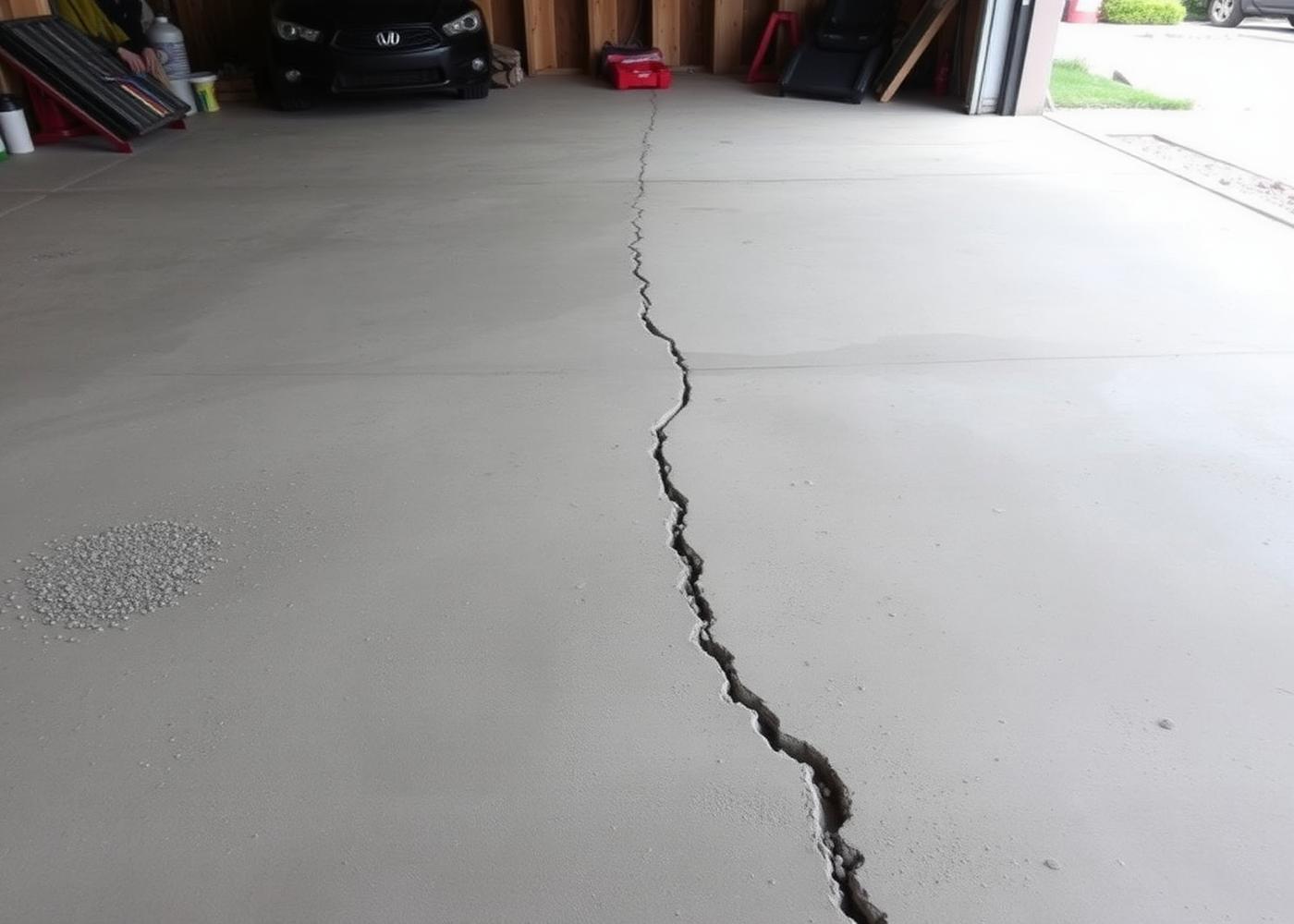
Concrete shrinks as it cures, and hairline shrinkage cracks are normal in nearly every slab. So are cracks at control joints, and map-pattern crazing on an exposed surface. The features that separate structural concern from cosmetic cracking are vertical offset across the crack, progressive growth, and a matching elevation difference. That distinction is why crack repair should follow diagnosis rather than replace it.
Fig. — Piers carrying slab load past the seasonally active clay zone
Have measurements taken first
Elevation readings tell you whether the slab has actually moved and by how much.
Stabilization methods
When pier systems come into play
Piers are specified when the soil that used to carry the slab no longer can, and the goal is to move that load onto something that doesn't change with the weather.
Steel push piers
Pipe sections driven hydraulically using the weight of the house until they reach resistance. Well suited to full-height masonry homes with adequate dead load.
Helical piers
Screw piles torqued into place, with capacity verified during installation. Preferred where structures are too light to drive a push pier.
Staged leveling
Where lifting is appropriate, elevations come up gradually so finishes and plumbing aren't shocked into new damage.
Not every settled slab gets piers. Where the cause is a plumbing leak or a drainage defect, fixing the water source and monitoring for a season is often the correct first move — and considerably cheaper. See the Oklahoma cost guide for what each path typically runs.
Statewide
Get a slab repair estimate
Slab work is available across our coverage area, including Edmond, Moore, and Broken Arrow.
Slab foundation repair questions
Can a cracked slab be repaired without piers?
Yes, when measurements show the slab isn't moving. Epoxy or polyurethane injection restores continuity in a stable crack, and cosmetic finishes get patched. Piers enter the picture when elevations prove the concrete is being carried by soil that no longer supports it.
How is a post-tension slab different to repair?
Post-tension slabs contain tensioned steel cables running through the concrete. Nobody should cut or core one without locating the tendons, which makes interior pier placement and plumbing repairs more involved. Tell any contractor if you have or suspect a post-tension slab.
Does the slab get lifted back to level?
Sometimes partly. A crew may lift toward the original elevation where the structure can tolerate it, or stabilize at the current position to prevent further movement. Aggressive lifting of a slab that has cured out of plane can create new cracking, so the target should be stated in the proposal.
How many piers does a settled slab need?
It's driven by the length of the affected perimeter and the spacing the contractor specifies for your soil and load. Some jobs need six; some need thirty. Insist on a drawing showing locations rather than a lump-sum number.
Will interior piers mean tearing up my floors?
Interior work requires opening the floor covering and cutting access through the slab at each pier location, then patching. It's disruptive but sometimes necessary when the low area extends well inside the footprint rather than sitting at the perimeter.